Type 2, Type 1, Schuko, red CEE, blue CEE, Mode 2, Mode 3 - the terminology of EV charging can seem confusing at first. In reality the system is logical once you go through it. In this article we introduce all the connectors and plugs you will encounter in Finland and explain which cable or charger fits which connection.
Car-end connectors: Type 2 and Type 1
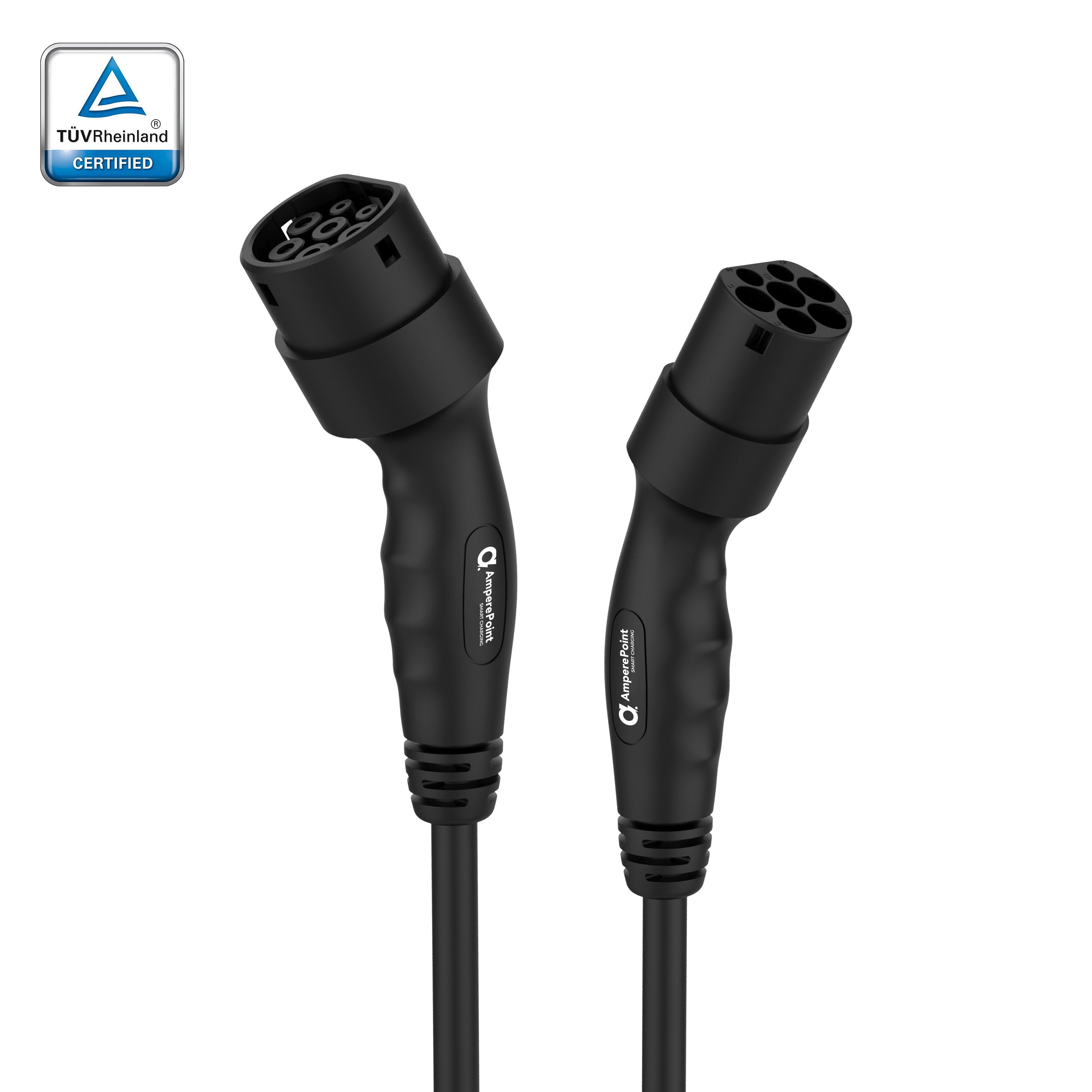
Type 2 (IEC 62196-2) is the European standard connector for AC charging. It is found on practically all new electric cars sold in Europe and on all public AC charging stations. Type 2 supports three-phase charging up to 22 kW, so the same connector serves both 3.7 kW home charging and 22 kW fast AC charging.
Type 1 (SAE J1772) is an older, single-phase connector found mainly on import cars: for example older Nissan Leaf and Mitsubishi Outlander PHEV models. A Type 1 car needs either a charger with a Type 1 connector, such as the B35 Type 1, or a Type 2 → Type 1 adapter.
Wall-end sockets: Schuko and CEE
Schuko is the regular household socket: 230 V and one phase. It works for charging with a portable charger, but continuous current should be limited to 8-10 amps, giving about 1.8-2.3 kW. For long-term charging outdoors, consider a purpose-built outdoor socket such as the Schuko version of the Dr. Storm series.
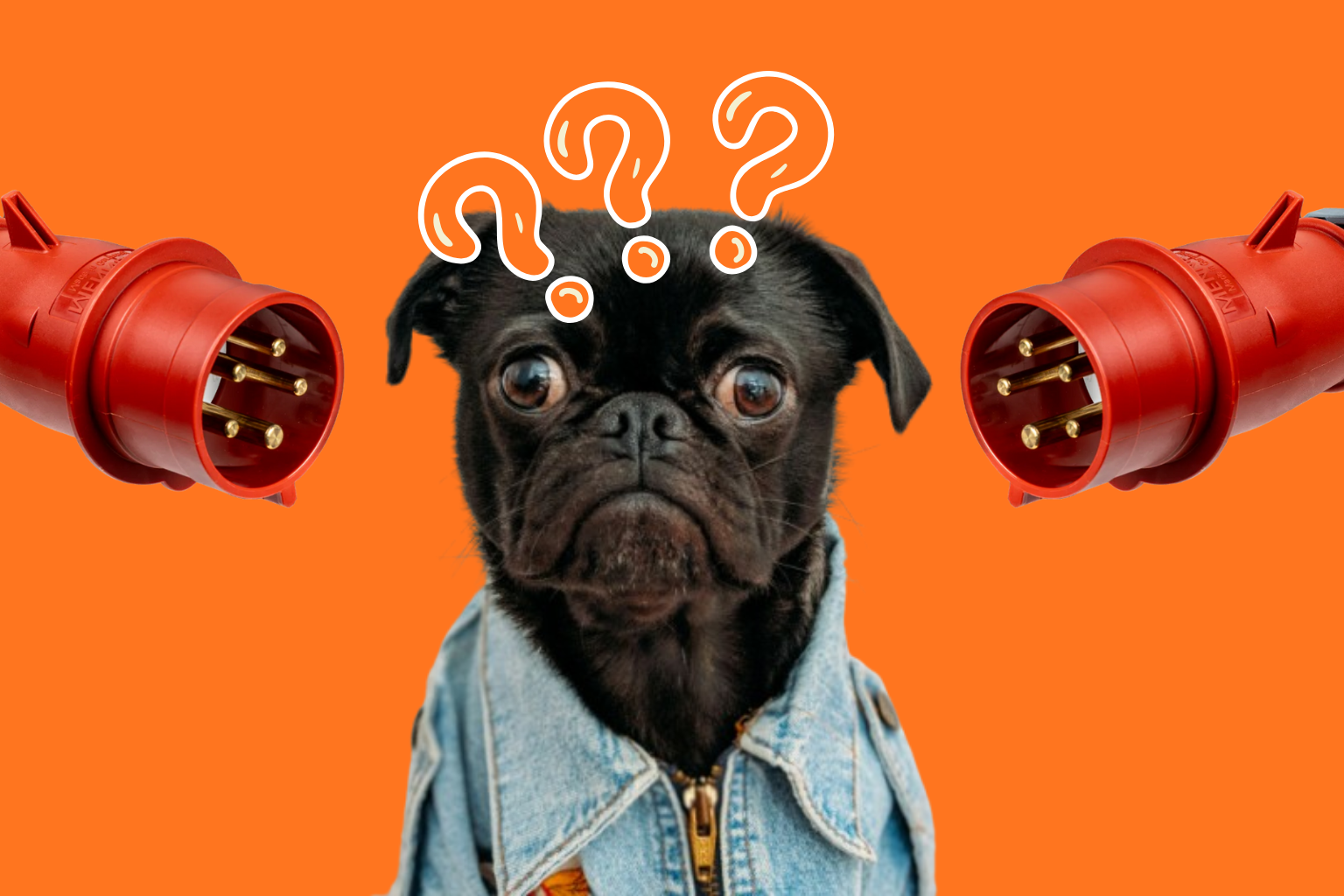
Red CEE is the three-phase 400 V industrial socket. CEE16A supplies 16 A, i.e. up to 11 kW, and CEE32A supplies 32 A, i.e. up to 22 kW. These are the best connections for portable charger use, because they enable full three-phase charging power.
Blue CEE is known as the camping socket: a single-phase 230 V connection seen at marinas, campsites and cottages. Blue CEE16A gives 3.7 kW and the heavier blue CEE32A gives 7.4 kW single-phase. Adapters for both are available for the Q PRO chargers.
Mode 2 and Mode 3 - what the difference means
Mode 2 means charging from a socket with a portable charger whose cable has its own control and protection unit. All Ampere Point portable chargers (B, P and Q series) are Mode 2 devices: residual current protection, temperature monitoring and current adjustment travel with the charger.
Mode 3 means charging from an AC charging station, where the protection and control are in the station. A Mode 3 cable, such as the Mamba S11 or S22, is used between the car and the station. An important rule of thumb: a Mode 3 cable is not an extension cord and does not replace a charger - it must not be plugged into a socket or used with adapters.
What about CCS and fast charging?
Public fast charging stations use the CCS connector, which is essentially Type 2 supplemented with two DC power pins. You do not need your own cable for fast charging: the cables at DC stations are always fixed, because at high power the cable is a liquid-cooled, monitored part of the station. Your own cable and charger are needed only for AC charging - that is, at home, at work and at public Type 2 stations.
Which cable or charger for which connection
| Connection | Suitable solution | Power up to |
|---|---|---|
| Public AC charging station (Type 2) | Mode 3 cable: Mamba S11 or S22 | 11 / 22 kW |
| Household socket (Schuko) | Mode 2 portable charger: B35, P35 or Q37 | 3.7 kW (8-10 A continuous) |
| Red CEE16A (three-phase) | P11 or Q11 | 11 kW |
| Red CEE32A (three-phase) | P72 (1 phase) or Q22 (3 phases) | 7.2 / 22 kW |
| Blue CEE (camping) | Q PRO charger and a blue CEE adapter | 3.7 / 7.4 kW |
| Car with a Type 1 inlet | B35 Type 1 or a Type 2 → Type 1 adapter | 3.7 kW |
Summary
In Finland things are ultimately simple: a new EV has a Type 2 connector, at public stations you need a Mode 3 cable, and at home you choose a Mode 2 portable charger to match your socket, or a fixed charging station. Once you identify your socket and your car's connector, the right device is straight in the table.
You will find a full range covering every connection type in our webshop - charging cables, portable chargers, adapters and wallbox chargers all TUV certified.