
Charger brochures are full of the numbers 11 kW and 22 kW, but when you charge, the meter often shows something quite different. This is usually not a fault but a consequence of how AC charging works: the realised power is always the power of the weakest link in the chain. In this article we go through what charging power really consists of and why the promised 11 kW is not always 11 kW.
What AC charging power consists of
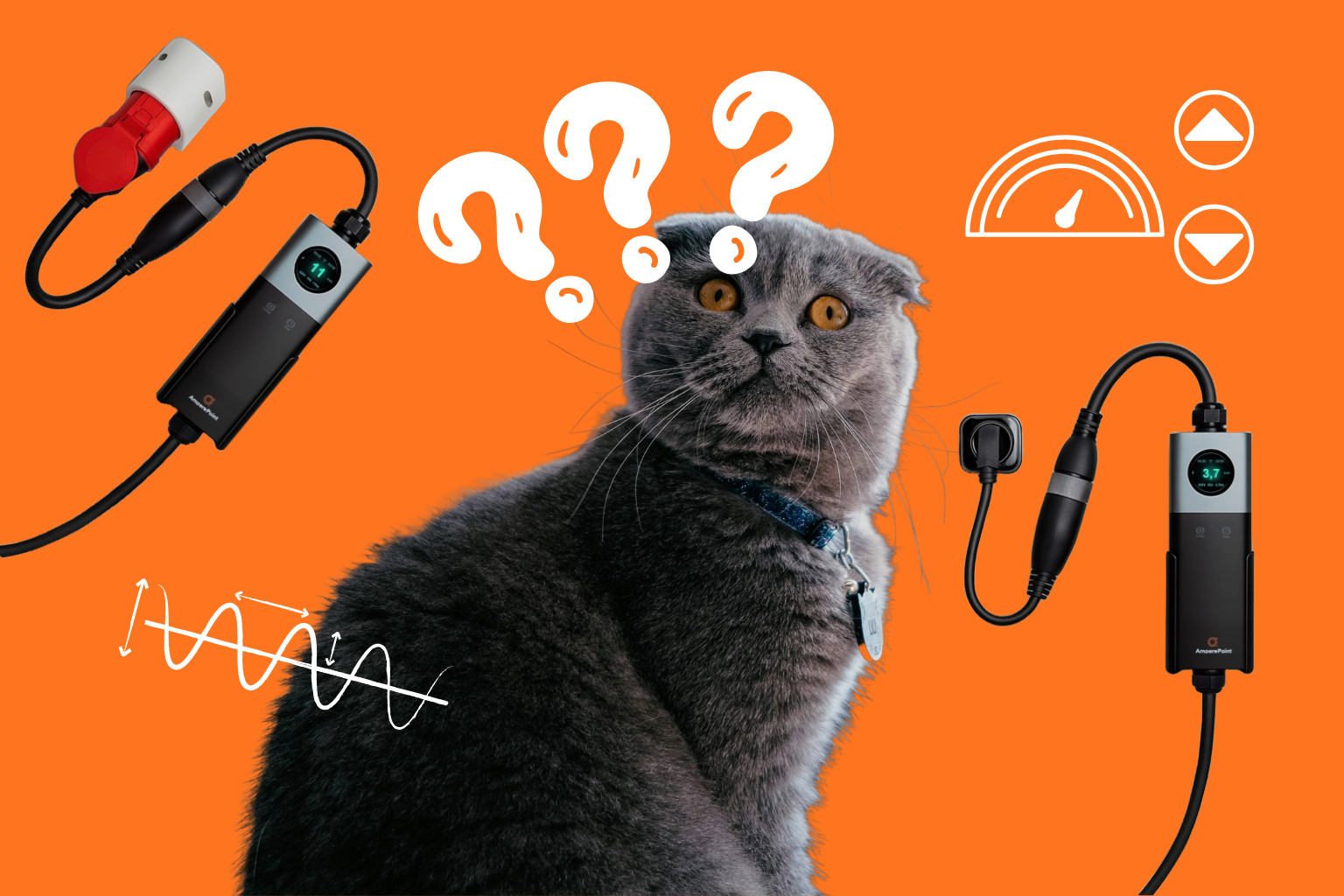
AC charging power is simple multiplication: voltage times current times the number of phases. One phase at 230 volts and 16 amps produces 3.7 kW. With three phases the same 16 A means 11 kW, and 32 A on three phases means 22 kW. Every part of the chain - the socket, the charger, the cable and the car - sets its own limits on current and phases, and the final power is determined by the smallest of these.
The car's on-board AC charger decides
In AC charging, mains power is converted for the battery by the car's own on-board charger, and it is this charger that sets the upper limit. If the car's on-board AC charger is 11 kW, the car charges at 11 kW even from a 22 kW station - a more powerful station or cable does not speed up charging at all. Most full EVs have an on-board AC charger of at most 11 kW, and in many plug-in hybrids it is 3.7 kW. Before buying equipment, always check your car's maximum AC charging power.
One phase or three phases
Another common surprise is the number of phases. Some cars charge on one phase only, so even a three-phase station delivers only single-phase power. Example: an 11 kW station supplies 16 A on three phases, but a single-phase car uses only one of them - the realised power is 3.7 kW. The same applies in reverse: a car that supports three-phase charging does not fully benefit from a powerful single-phase supply, because in Finland single-phase charging current is in practice limited to 16 amps.
Fuses and the connection set their own limits
The home electrical connection is the third limiting factor. A typical detached house has 3×25 A main fuses, and 16 A three-phase charging takes a significant share of that. That is why quality chargers have current adjustment: the charging current can be reduced, for example while the sauna is on. Wallbox PRIME stations also have dynamic load balancing, which automatically matches the charging power to the rest of the house's consumption. When charging from a regular Schuko socket, continuous current should be limited to 8-10 amps, giving a real power of about 1.8-2.3 kW.
Promised vs. realised power: typical cases
| Situation | Device power | Realised power | Why |
|---|---|---|---|
| 22 kW station, car's AC charger 11 kW | 22 kW | 11 kW | The car's on-board charger limits |
| 11 kW station, single-phase car | 11 kW | 3.7 kW | The car uses only one phase |
| 11 kW wallbox, plug-in hybrid (3.7 kW) | 11 kW | 3.7 kW | The PHEV's on-board charger is single-phase |
| 22 kW station and 22 kW car, 16 A cable | 22 kW | 11 kW | A 16 A cable carries at most 11 kW |
| Schuko socket and a 3.7 kW portable charger | 3.7 kW | approx. 1.8-2.3 kW | Continuous charging is limited to 8-10 A |
| Housing company station with load management | 11 kW | varies | Current drops during consumption peaks |
How to verify the real power
First check your car's on-board AC charger power and number of phases, then the available socket or station, and finally the cable rating. For most people the right combination is 11 kW: it fills the car overnight without unreasonably loading the connection. The Mamba S11 cable (16 A) covers the majority of needs, and the Mamba S22 (32 A) is the right choice only if the car really supports 22 kW AC charging.
Also remember that some of the charged energy is lost: the car's electronics, charger heating and battery management typically take about 10-15 percent. The lower the charging power, the higher the relative share of losses - another argument for three-phase charging whenever it is possible.
Once you know your car's real AC charging power, choosing the right device is easy. Explore charging cables, portable chargers and wallbox chargers in our webshop - we are happy to help with sizing too.